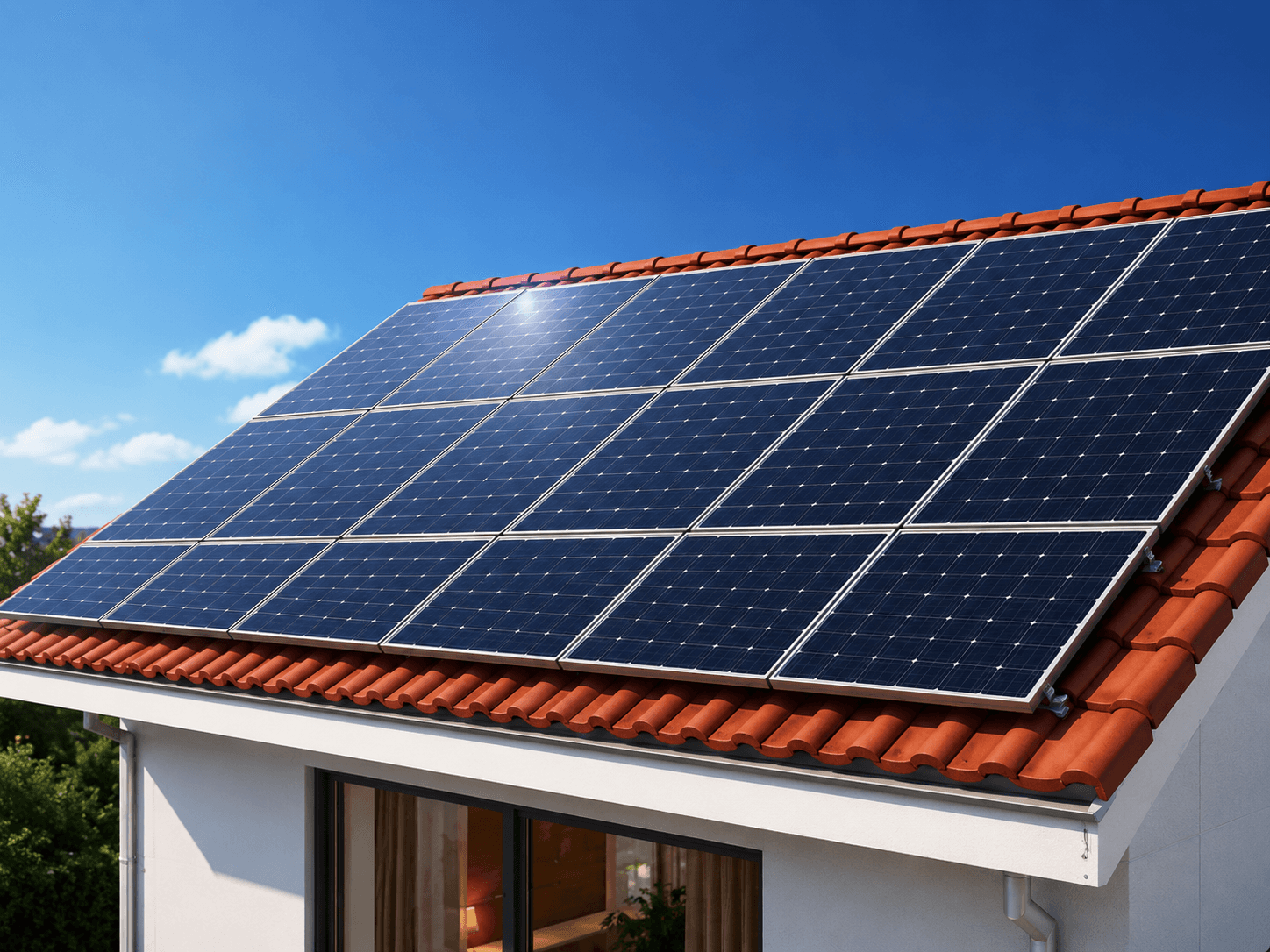
Why a solar pump instead of a conventional one
Water demand and panel output overlap almost perfectly: in summer, when plants need the most, there is also the most sun. That is why a solar pump needs no batteries — the water in the tank is the battery.
Grid or generator
A connection to run all the way to the field, or a generator that needs diesel, oil and someone to start it. The cost grows with every hour of pumping.
Straight from the panels
The panels feed the inverter, the inverter starts the pump in the morning and stops it in the evening. Operating cost after installation is zero.
Four situations where they pay back quickly
Simple rule: the further from the grid and the more hours a day you pump, the sooner it pays for itself.
Field crops and orchards
You pump into a tank during the day and irrigate from there by gravity or drip. The system works exactly in the months you need it.
Livestock watering
Constant daily demand, all year. Here a solar pump replaces a grid connection you would otherwise pay for monthly, for nothing, including in winter.
Isolated house or cabin
Your own well, no grid nearby. With an elevated tank you get pressure in the house without a booster pump and without electricity.
Ponds and basins
Recirculation and oxygenation, where the pump runs many hours a day and the electricity bill would be the main operating cost.
From a household to a farm of hundreds of hectares
The inverters cover pumps from 0.75 kW (1 HP) up to 150 kW. Small models are single-phase, those from 1.5 kW upwards are three-phase with a variable frequency drive. Exact sizing is done on water depth and the flow rate you need.
| Power class | Max pump | Supply | Suitable for |
|---|---|---|---|
| 0.75 – 2.2 kW | 1 – 3 HP | Single-phase 220/240 V | Household, garden, small-scale livestock watering |
| 3.7 – 5.5 kW | 5 – 7.5 HP | Three-phase 380/400/440 V | Deep household well, greenhouse, small orchard |
| 7.5 – 15 kW | 10 – 20 HP | Three-phase 380/400/440 V | Irrigation over tens of hectares, livestock farm |
| 18.5 – 55 kW | 25 – 75 HP | Three-phase 380/400/440 V | Large holdings, fish farming, irrigation networks |
| 64 – 150 kW | 85 – 200 HP | Three-phase 380/400/440 V | Large-scale projects, communal water systems |
The table is indicative, by power class. The exact inverter and pump model are chosen together, based on well depth and required flow.
SJ30-16 — the 15 kW pump
One model from the range, with the full datasheet. A stainless steel multi-stage submersible pump with an integrated check valve, replacing conventional long-shaft deep-well pumps.
The hydraulic curve is measured with water at 20 °C, density 1000 kg/m³, at 1 bar atmospheric pressure (ISO 9906 grade 3B). For other flow rates and depths we have equivalent models in the same series — sized on request.
What protects the pump
Most pumps fail not from wear but from an avoidable accident: running dry when the water level drops, or a lightning strike. The inverter covers both.
Dry-run
Water level sensor in the well or software detection. When the level drops below the threshold the inverter stops the pump and restarts on its own when it recovers.
Lightning protection
Surge arresters on the DC input — essential for a panel array mounted out in the open, far from buildings.
Tank full
Automatic stop when the tank fills, with nobody standing by to watch it.
Electrical and thermal
Short circuit, overload, overcurrent, over-temperature, DC reverse polarity, phase loss and imbalance on three-phase.
Inverter technical specifications
The common characteristics of the HSPH series — solar input, pump output, protections and operating environment. Open the class you are interested in.
Source: Yangzhou Bright Solar Solutions datasheet for the HSPH series and the inverter user manual. Full PDF datasheets available on request.
Tell us what you have, we tell you what you need
You do not need exact figures to ask for a quote. Fill in what you know — we calculate the rest and come back within 48 hours with the sizing and the price.
An approximation is enough. If you do not know, leave it blank — we work it out.
Use whatever unit is easy for you: hectares, number of animals, cubic metres per day.
We reply within 48 hours at the latest. Your details go nowhere else.